Showing posts with label Trekking. Show all posts

Friday, 3 January 2014

Explorer Returns To South Sudan Despite Looming Civil War

If you have been keeping up on current events lately, you probably already know about the turmoil that is going on in South Sudan, the youngest country on the planet. The nation was formed following a long struggle against leaders in Sudan, but almost since the day the nation first gained its independence, political struggles and old rivalries have threatened to break it apart. That all boiled over in mid-December and now the country is in open conflict with factions that have been rivals for years falling back into old familiar territory now that their common enemy had been defeated. At the moment, thousands of South Sudanese citizens are displaced and hundreds have been killed. It is, at times, a violent and unpredictable place, where foreigners are discouraged from traveling to.

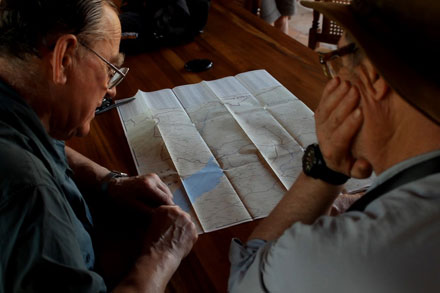
That is the environment that explorer and anthropologist Julian Monroe Fisher is facing as he returns to South Sudan to continue his work there. He departs Austria today to launch the third phase of his Great African Expedition, a four year, multi-phase plan to explore the ethnographical make-up of central Africa and study how it has changed over the past two centuries.

Julian has also been instrumental in developing a new long distance trekking route dubbed the "Sir Samuel and Lady Florence Baker Historical Trail." This new route, which begins in South Sudan and runs into Uganda, is more than 500 miles (805 km) in length and has been designed for backpackers and long distance hikers. The hope is that the trail will draw a much needed economic boost to the region, which lacks jobs and other resources currently.

On this visit, Fisher plans to hike the entire length of that route for the first time. That could be risky however, as the trail begins near the town of Gondokoro, which is located not far from the capital of Juba. That area has been hit hard by the current civil unrest in the country.


When I heard from Julian earlier in the day he was just preparing to leave for Africa. His contacts in the country assure him that he will be safe and that they will do what they can to securely deliver him to the trail. For his part, the explorer says that he is not concerned about his own safety and welfare but instead would like to call attention to what is happening in South Sudan. Much of the conflict stems from long standing ethnic disputes between the Dinka and Nuer people, which Fisher compares to the 1990's conflict in Rwanda. He hopes his efforts will help draw a focus on the South Sudanese conflict that will hopefully prevent another genocide like the one that took place in Rwanda.

The current expedition is set to last up to two months and Julian will post updates from the field as he goes. Hopefully he'll not only get the chance to hike the trail that he has been helping to develop but he'll remain safe along its entire length. His mission there is a good example of explorers visiting dangerous places with the hope that they can help improve conditions there in the future.

Tuesday, 17 December 2013

Best Hike Treks The Manaslu Circuit

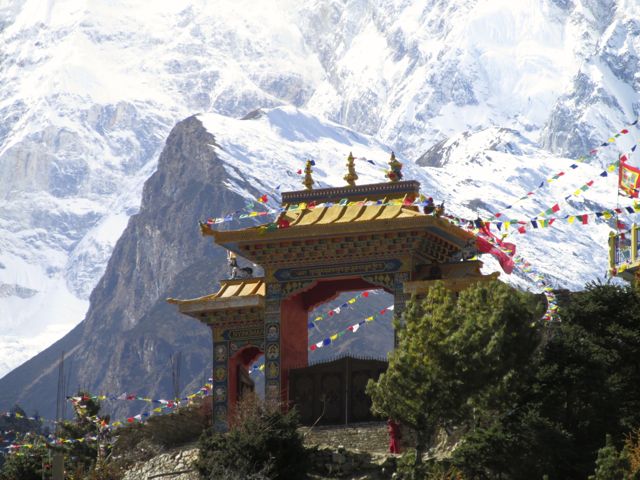
My friend Rick McCharles of Best Hike fame is up to his usual tricks. Rick recently to Nepal where he walked the Manaslu Circuit, a 252 km (156.8 mile) sojourn that takes roughly 12-13 days to complete. Following his Himalayan adventure, Rick has posted his thoughts on the trek, sharing daily info on the walk and lots of beautiful photos as well.

As the name implies, this hiking circuit encircles Manaslu, an 8156 meter (26,759 ft) peak that is located in west central Nepal. The trail first opened back in 1991, but Rick says that it has gained in popularity over the past few years as more tea houses have sprung up along the route, giving trekkers more comfortable options for their adventure.

All told, the circuit features 12,585 meters (41,289 ft) of climbing and 11,279 meters (37,004 ft) of descent. It reaches its highest point at Larkya Pass, which falls at 5106 meters (16,751 ft). While that is plenty of altitude, Rick says that it rises at an acceptable rate, allowing plenty of time to acclimatize. The route will take you through six climate zones along the way, giving backpackers an opportunity to experience a host of beautiful scenery. As with most treks through the Himalaya in Nepal, it also exposes travelers to the great culture there as well.

Rick spent a total of ten days on his hike and from the sounds of his reports, he enjoyed every minute of it, despite some challenges. The thing that intrigues me most about his notes on the hike is that he compares it quite favorably to the legendary Annapurna Circuit from years past. There are many long distance hikers who feel the Annapurna Circuit is the best hiking trail in the world, although the addition of a road to the region altered that perception some. If the Manaslu Circuit is anywhere near as good, it says a lot about just how amazing this walk must be.

If you're looking for a new adventure for 2014, then perhaps the Mansaslu Circuit should be added to your list of potentials. Rick says October and November are the best times to go, although April and May aren't bad either. It looks like yet another amazing Himalayan hike I need to add to my bucket list.

Friday, 13 December 2013

Gear Closet: SPOT Satellite Messenger Gen3

When it was released a few years back the SPOT Satellite Messenger was a revelation to the outdoor community. Not only did it allow us to call for help in case of emergencies, it allowed us to send preset messages back home to let the know everything was okay, even while we were in remote areas. On top of that, it shared GPS coordinates online, giving friends and family the opportunity to see where we were located at any given time. All of that was rolled up in a small, lightweight package with solid battery life and an easy to use interface. The device was later updated with some evolutionary changes that slimmed down the Satellite Messenger slightly and added some measures that made it more difficult to inadvertently set off the SOS button.

This past summer, SPOT released the Gen3 Satellite Messenger which brings more substantial improvements to the Messenger. The device did get a bit larger in size but it made up for it much improved battery life. The new model is capable of running for twice as long as previous Satellite Messengers, which is an always a welcome upgrade. That improved battery life is put to good use, allowing the new device to be much more active. Two new GPS location sharing setting are available, allowing users to post updates every 2.5 or 5 minutes, in addition to the standard 10, 30 and 60 minutes. Sharing coordinates that often is probably overkill when backpacking in the backcountry, but it is nice to know the capability is there should you need it. In a further battery saving mode, the new SPOT unit will even shut itself off when it detects that you haven't moved for an extended period of time. That puts it into battery saving mode to conserve power. As soon as you're back on the go, it'll resume sharing data at the usual rate that you've set.

The new model also has multiple ways to keep itself charged as well. In addition to the standard, long life, rechargeable battery pack, the Gen3 is also capable of using off the shelf AAA batteries, which don't have the luxury of lasting as long as the rechargeable pack, but they are inexpensive, easy to find, and small enough to easily carry. The device can also be powered directly from a USB port, which can come in handy when wanting to use it to track a vehicle for instance and you don't want to run the batteries down completely.


Of course, the Gen3 still does everything the old models did in terms of sending pre-canned messages and having the ability to call for an emergency evac. Those features are often what owners most want out of the device, eschewing the tracking abilities in favor of at least being able to travel more safely and confidently in remote places.

I've had the good fortunate of testing the Gen3 for several months now and feel that it is a solid update to a device that was already quite good. It remains lightweight and durable, it tracks accurately and its ability to communicate with others back home, remains solid and reliable. Essentially, it is everything that we've come to know and love about previous SPOT devices, just improved in some important and useful ways.

The Gen3 also remains very affordable. It carries an MSRP of $169.95, which is a low cost of entry for a device that provides some excellent safety measures for our adventures. Of course, the Satellite Messengers itself isn't very good without service, and in order to use it you'll need to sign up for a monthly plan. Basic service runs $149.95 for the year, or about $12.50 per month, with extended tracking abilities adding more expense to the price tag.

With the holidays just around the corner, the SPOT Gen3 would make a great Christmas gift for your favorite outdoor enthusiast. It gives them the ability to travel in the remote corners of the globe without worry, and it'll give you peace of mind knowing that should an emergency arise, they'll be able to quickly and easily call for help. I can't think of a better gift for them or you.

The SPOT Gen3 is a solid update in every way, giving first time buyers the best device the company has ever created. The Gen3 is so good in fact, that it should entice owners of previous models to upgrade as well. The improved battery life is worth the update alone, but the other features are certainly icing on the cake.